
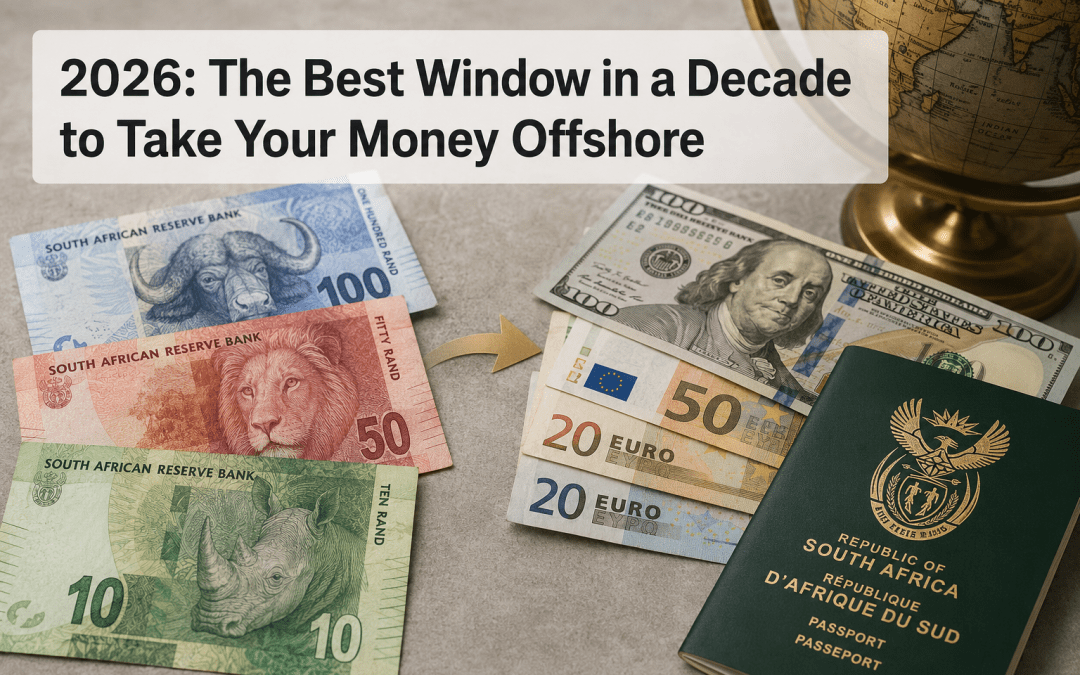
How the New SDA Limit, FATF Exit, and Budget Reforms Are Opening Doors – and Why You Cannot Afford to Wait
The Risk You Are Already Taking
Here is something most South Africans do not think about until someone points it out: if your entire investment portfolio is concentrated in South African assets, you are not playing it safe. You are making one of the riskiest bets available – a single-country, single-currency wager on a small emerging market economy.
The Johannesburg Stock Exchange, while home to some excellent companies, represents less than 1% of global market capitalisation. That means 99% of the world’s investment opportunities sit outside your reach if you are only invested locally. And the risks of that concentration are not theoretical. Rand depreciation has eroded the purchasing power of rand-denominated assets consistently over time. Political and policy uncertainty can move the JSE dramatically in a single news cycle. Infrastructure challenges – from energy supply to logistics – continue to weigh on corporate earnings and growth. And sector concentration on the JSE means you are heavily exposed to a handful of industries, with limited access to the global growth sectors that have driven wealth creation over the past decade.
This is not a doom-and-gloom take on South Africa. It is a basic statement of investment reality: concentration risk in any single market is dangerous, and the smaller and more volatile that market, the more dangerous it becomes. Diversification is the most fundamental principle in investing. For South Africans, that means looking beyond your borders.
The question is not whether you should invest offshore. It is why you have not done it yet.
2026: The Best Window in a Decade
The environment for offshore investing from South Africa is the most favourable it has been in at least ten years. That is not hyperbole. Consider what has changed in just the past few months.
The Single Discretionary Allowance has doubled to R2 million. You can now move a meaningful amount of capital offshore each year without needing a TCS PIN from SARS or approval from the Reserve Bank. Previously, the R1 million SDA was useful but limited – not enough to build a properly diversified international portfolio without going through the administrative burden of the formal approval process. At R2 million, you can establish a serious position in global markets with minimal friction.
South Africa’s removal from the FATF grey list in October 2025 has eased the international compliance environment around South African-origin transactions. Correspondent banks are normalising their risk assessments. Processing times are improving. The automatic red flags that accompanied South African transfers during the grey listing period are being removed. Moving money out of the country is practically easier than it has been in years.
The country secured its first credit rating upgrade in 16 years, signalling improving fiscal credibility to international investors and institutions. The 2026 Budget withdrew the R20 billion in previously announced tax increases and fully adjusted personal income tax brackets for inflation for the first time in two years. The Tax-Free Savings Account annual limit jumped to R46,000, creating more room for tax-sheltered investing.
Each of these changes is significant on its own. Together, they create a window of opportunity that did not exist twelve months ago. The question is how long it stays open.
Why Favourable Windows Close
If you have been following South African financial news for any length of time, you know that conditions can change rapidly and without warning.
In 2025, the VAT increase controversy threw the entire budget process into turmoil and created months of uncertainty for anyone with cross-border financial plans. During the grey listing period, some international institutions simply stopped dealing with South African clients. Exchange control rules have been tightened, loosened, and tightened again over the past decade. SARS’s approach to compliance and enforcement has intensified significantly, and there is no indication that trajectory will reverse.
And right now, the Iran conflict is sending shockwaves through global markets. Oil prices have surged. The Strait of Hormuz – through which roughly 20% of the world’s oil supply passes – faces disruption. Safe-haven currencies like the US dollar are strengthening, putting pressure on emerging market currencies including the rand. The VIX volatility index has jumped nearly 60% since the start of the year. Gold has pushed past USD 5,300.
For South Africans with money locked in rand-denominated assets, this kind of global turbulence is a reminder of exactly why offshore diversification matters. When the next shock hits – and there is always a next shock – you want some of your wealth sitting outside the blast radius.
The people who diversified before the shock are protected. The people who were going to get around to it eventually are watching the rand weaken and wishing they had moved faster.
What Is Actually at Stake
Let us put some numbers around the cost of inaction.
The SDA resets every January 1. If you did not use your R2 million allowance last year, it is gone. You do not get R4 million this year to make up for it. Over a five-year period, that is R10 million in transfer capacity that simply evaporates if you do not use it.
Meanwhile, the rand has depreciated against the US dollar by roughly 40% over the past decade. If you had moved R1 million offshore ten years ago, it would have bought you substantially more foreign currency – and substantially more investment exposure – than R1 million buys you today. The purchasing power of your South African savings is shrinking in global terms with every year that passes.
And the compounding effect of being invested in global markets – markets that have significantly outperformed the JSE over most meaningful time periods – means that every year you delay is not just a year of missed returns. It is a year of missed compound growth that you can never recover.
The cost of procrastination does not show up on a bank statement. But it is real, and it accumulates relentlessly.
The Complexity That Catches People Out
If offshore investing from South Africa were as simple as opening a foreign brokerage account and wiring money over, everyone would have done it already. It is not. And the complexity is where people either lose money through mistakes or leave money on the table through suboptimal structuring.
South African tax residents are taxed on their worldwide income. That includes dividends, interest, and capital gains from offshore investments. The interaction between South African tax obligations and the tax rules in the jurisdiction where your investments are held can create double taxation issues if not managed carefully. You may be entitled to foreign tax credits, but claiming them correctly requires an understanding of both systems.
Exchange control regulations still govern how much you can move offshore and through which channels. The SDA covers the first R2 million without a TCS PIN, but if you want to move more – using the Application for International Transfers (AIT) process – the compliance requirements are more involved and the timelines less predictable.
The choice of investment vehicle matters. There are significant differences in tax treatment, reporting obligations, and accessibility between investing through a South African platform with an offshore mandate versus investing directly through an international provider. The right choice depends on your specific circumstances, your tax residency status, your time horizon, and your goals.
The exchange rate at the time of your transfer directly affects your effective entry price into foreign markets. On a R2 million transfer, a 2% to 3% difference in the rate translates to real money. How you time your transfers, which provider you use, and whether you move everything at once or spread it across multiple dates all have measurable consequences.
And your reporting obligations to SARS are non-negotiable. South African tax residents must declare their offshore assets and income on their annual tax return. Getting this wrong – whether through ignorance or carelessness – is a compliance risk that can result in penalties, interest, and a great deal of unwanted attention from SARS.
Each of these elements is manageable. But managing them all simultaneously, while keeping them aligned with your broader financial position, is not something most people can do effectively on their own.
Why People Who Get Help Come Out Ahead
The South Africans who build the most effective offshore portfolios are not the ones who know the most about exchange control regulations or tax law. They are the ones who recognise that this is specialist territory and bring in the right expertise early.
They get advice on structuring their SDA and AIT transfers for maximum efficiency. They understand the tax implications before they invest, not after. They use providers who offer competitive exchange rates rather than accepting whatever their retail bank offers. They have someone coordinating the compliance requirements so that nothing falls through the cracks. And they do not waste years of SDA allowance because they were going to get around to it eventually.
The ones who come out worst are the ones who delayed, who relied on outdated advice, or who treated a complex, multi-jurisdiction financial decision like a DIY project.
Your wealth is not going to diversify itself. And the window that exists right now – with the doubled SDA, the grey list exit, the stable Budget, and the favourable compliance environment – is not guaranteed to stay open.
Take the First Step Today
At FinSelect, we help South African investors plan and execute their offshore strategies. We do not just process transfers – we help you think holistically about your cross-border financial position, from the structure of your investments to the timing of your transfers to the tax implications in both South Africa and your destination.
We have helped South Africans across the world take control of their offshore investing, and we know the difference that professional guidance makes – not in theory, but in the actual rands and cents that land in your international account.
The 2026 environment is the most favourable we have seen for South Africans going global. Do not let it pass you by while you think about it for another year.
Contact Rudi at FinSelect today. Email rudi.stander@finselect.co.nz or DM us. Your money should be working as hard offshore as it does at home – and right now, the door is wide open.
