
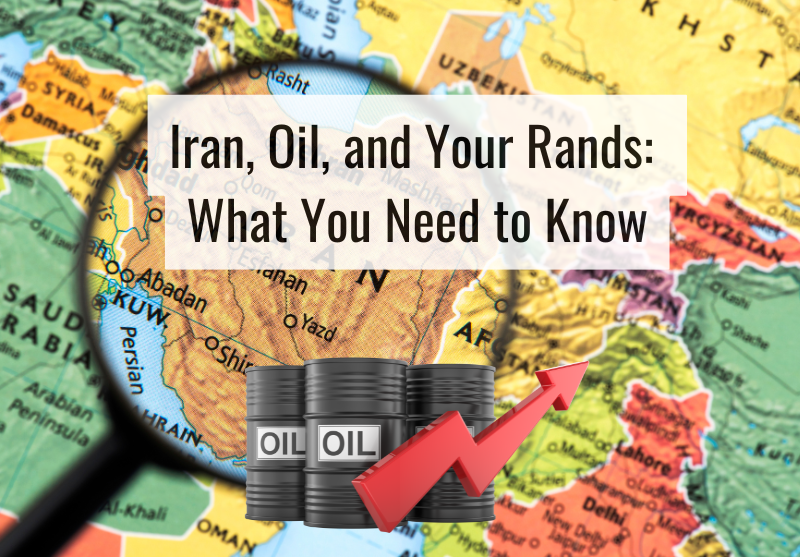
Oil Prices Are Surging, the Rand Is Under Pressure, and Your Cross-Border Finances Are Caught in the Middle
What Is Happening and Why It Matters to You
On 28 February 2026, the United States and Israel launched coordinated military strikes on Iran in what has been dubbed Operation Epic Fury. Within hours, Iran retaliated with missile and drone attacks on Israel and US military bases across the Gulf – hitting targets in Saudi Arabia, Qatar, Kuwait, the UAE, Bahrain, and Iraq. Iran’s Supreme Leader Ayatollah Ali Khamenei was killed in the strikes. The Strait of Hormuz – through which roughly 20% of the world’s oil supply passes – is effectively closed to tanker traffic. The conflict is now in its third day and shows no sign of stopping.
If you are a South African with money on both sides of a border – whether you are an expat, an investor, or someone planning to move funds abroad – this is not background noise. This conflict is already moving the numbers that directly affect your financial position.
Brent crude surged over 13% in early Monday trading before settling around 8.5% higher – its biggest daily jump in nearly three years. European natural gas prices spiked more than 20%. Gold pushed past USD 5,300 as investors scrambled for safe havens. The US dollar strengthened as capital fled emerging markets. And the rand weakened to R16.17 against the dollar on Monday before recovering slightly to around R16.11.
For South Africans trying to move money offshore, invest internationally, or manage cross-border obligations, every one of those numbers matters. And most of them are moving in the wrong direction.
The Oil Price Problem
South Africa imports virtually all of its crude oil. When global oil prices spike, the cost of fuel in South Africa goes up – and because fuel is an input cost for almost everything in the economy, inflation follows.
The Strait of Hormuz is the single most important oil chokepoint in the world. On a normal day, roughly 15 million barrels of crude pass through it. Since the conflict began, tanker traffic has effectively stopped. Insurance companies will not cover vessels transiting the strait, and without insurance, ships do not move. Four vessels have already been hit in Gulf waters.
OPEC+ announced a production increase of 206,000 barrels per day on Sunday, but that is a drop in the ocean compared to the volume that flows through Hormuz. If the strait remains closed for weeks rather than days, analysts are warning of sustained price levels that could push Brent well above USD 100 per barrel.
KPMG’s lead economist for South Africa has warned that higher oil prices will drive broad-based inflation through increased transport costs, potentially stalling the Reserve Bank’s interest rate cutting cycle and weighing on economic growth. Higher interest rates mean more expensive borrowing, less economic activity, and more pressure on the rand.
This is not a hypothetical scenario. It is happening right now, and the longer the conflict continues, the worse the economic impact becomes for oil-importing countries like South Africa.
What This Means for the Rand
The rand is an emerging market currency, and emerging market currencies are the first to suffer when global risk appetite evaporates. When geopolitical uncertainty spikes, international investors pull capital out of riskier markets and park it in safe havens – primarily the US dollar, US Treasuries, and gold.
That is exactly what is happening. The dollar has strengthened significantly since the strikes began. The VIX – Wall Street’s so-called fear gauge – has surged nearly 60% since the start of the year. Capital is flowing out of emerging markets across the board, and South Africa is no exception.
The rand had actually been performing reasonably well entering 2026. South Africa’s removal from the FATF grey list, the credit rating upgrade, and the reform-oriented Budget had all supported sentiment. The rand was trading comfortably below R16 against the dollar for stretches of February.
That resilience is now being tested. The R16.17 level hit on Monday represents a meaningful reversal, and if the conflict drags on – Trump has publicly suggested a four-to-five-week timeline – the pressure on the rand could intensify further. Sustained high oil prices, dollar strength, and risk aversion are a toxic combination for the South African currency.
For anyone holding rand-denominated assets and planning to convert them to foreign currency at some point, this is a live reminder that exchange rate risk is not an abstract concept. Every day the rand weakens against your target currency is a day your South African savings buy less abroad.
The Gold Lining – Literally
There is one partial offset for South Africa in all of this. Gold prices have surged past USD 5,300 per ounce, up roughly 25% in 2026 alone. As one of the world’s significant gold producers, South Africa benefits from higher gold prices through improved export revenues and mining sector earnings.
Higher gold prices support the trade balance and attract foreign capital into South African mining stocks, which partially cushions the rand against the broader emerging market selloff. It is one reason the rand’s decline has been more moderate than some other emerging market currencies.
But this is a partial and unreliable buffer. Gold prices can reverse quickly, mining sector benefits take time to flow through to the broader economy, and the negative impact of higher oil prices on inflation and growth is far more immediate and widespread than the positive impact of gold.
Relying on gold to protect your South African financial position from a major geopolitical shock is not a strategy. It is hope. And hope is not a financial plan.
Why This Conflict Makes Offshore Diversification Urgent
Every major geopolitical shock of the past decade has reinforced the same lesson: concentrated exposure to a single emerging market currency is a risk most people do not appreciate until it is too late.
During the grey listing period, South Africans watched their transfer capacity shrink as international banks tightened compliance. During load shedding crises, they watched the rand weaken and their purchasing power erode. During the 2025 Budget chaos, they watched policy uncertainty rattle markets and create months of financial limbo.
Now, a conflict that South Africa has no involvement in and no control over is pushing up the cost of everything from petrol to groceries, weakening the currency, and potentially derailing the interest rate cuts that were supposed to provide economic relief this year.
If your wealth is sitting entirely in rand-denominated assets, every one of these shocks hits you with full force. If you have diversified a portion of your portfolio offshore – into hard currencies, global equities, international property, or foreign bonds – the impact is cushioned. Your global assets may actually be increasing in value in rand terms while your South African assets come under pressure.
The SDA has just doubled to R2 million. The compliance environment is the most favourable it has been in years. The mechanisms exist to move your money efficiently and legally. The only missing ingredient is action.
The Danger of Waiting for Things to Calm Down
Every time there is a major market shock, people say the same thing: I will wait for things to settle down before I make any moves. It sounds reasonable. It feels prudent. And it is almost always a mistake.
Markets do not send you a notification when the uncertainty has passed. There is no bell that rings at the bottom. By the time things “calm down,” the exchange rate has often already moved against you, the opportunity has narrowed, and the next source of uncertainty is already emerging.
The people who benefit most from geopolitical volatility are the ones who had already diversified before the shock hit. They made their moves during a period of relative calm, when the rand was stronger and the compliance environment was easier. They did not try to time the crisis. They prepared for it.
The people who benefit least are the ones who keep waiting. Who tell themselves they will sort it out next month. Who watch the rand weaken and their purchasing power shrink and still do not act because the timing does not feel right.
There is never a perfect time. But there are clearly worse times – and waiting until the middle of a geopolitical crisis to start thinking about offshore diversification is one of them.
What You Should Do Right Now
If you have been thinking about moving money offshore, diversifying your investments, or formalising your cross-border financial position, the current environment is sending you a very clear message: do not wait.
The rand is under pressure. Oil prices are elevated and could go higher. The conflict shows no sign of quick resolution. And every day that passes without action is a day your South African savings are losing ground in global purchasing power.
At FinSelect, we help South Africans navigate exactly this kind of environment. We understand the interplay between exchange rates, transfer timing, compliance requirements, and investment structuring. We monitor the rand daily and help our clients make informed decisions about when and how to move their money for maximum value.
This is not the time for paralysis. It is not the time for DIY. And it is definitely not the time to wait and see.
Contact Rudi at FinSelect today. Email rudi.stander@finselect.co.nz or DM us. The world is moving. Your money should be too.
